
A College Park homebuyer guide should help you compare real addresses, not just pretty listing photos. If you are choosing between a bungalow, a renovated home or a townhome in College Park, use the same questions for every property: how it fits your daily life, what it may cost each month, which records need checking and what must be resolved before an offer.
This practical plan is for buyers considering College Park in Orlando, including ZIP code 32804. It is designed to help you build a short list and have a more focused conversation with your lender, inspector, insurance professional and real estate agent. It is not legal, tax, insurance or inspection advice, and it does not replace verification of a particular property.
College Park homebuyer guide: start with the address
“College Park” is a useful way to describe an Orlando area, but a neighborhood name or mailing address cannot answer every property question. Before you rely on a school, jurisdiction, permit office or historic-district assumption, look up the specific address. The City of Orlando provides a Check Your Address map for city limits and an official College Park neighborhood map. Use these as starting points, then confirm important details with the agency responsible for that property.
1. Write your must-haves before touring
Choose a few priorities you will use consistently. Examples include a maximum monthly housing budget, the number of bedrooms that work now, space for guests or remote work, outdoor space, stairs or accessibility needs, and how much repair or yard care you want to take on. Separate “must have” from “nice to have.” That keeps a charming finish or a busy showing from outweighing the parts of a home you will live with every day.
Decide how much uncertainty you can accept. Some buyers prefer a home with fewer immediate projects; others are comfortable evaluating an older house or planning updates over time. There is no universal best fit. Your budget, timing, property condition and appetite for maintenance should drive the choice.
2. Test the daily routine around each home
Map the trips that matter to you from each address: work, childcare, groceries, parks, healthcare, transit or visits with family. If possible, drive or walk the route at the time you expect to use it. Check parking, street access, lighting and the way the block feels at more than one time of day. Online maps help you plan; they cannot tell you whether a route suits your routine.
College Park includes different street patterns and home types. Compare the specific blocks you are considering instead of assuming that every home with a College Park label offers the same setting. Review the location in person and note the trade-offs that matter to you.
3. Compare the full monthly cost for each address
Do not compare homes by principal and interest alone. Ask your lender for an estimate using the price and loan terms you are actually considering. Then collect separate, address-specific estimates for property taxes, homeowners insurance, mortgage insurance if applicable, association dues, utilities and routine upkeep. Record the source and date for each number. Taxes can change after a purchase, insurance depends on the property and coverage, and utility or maintenance costs should not be guessed from a neighbor’s bill.
For an association property, request the current documents, fees, restrictions and any pending assessment information available to buyers. Confirm costs and requirements with the association and your closing professionals. For a side-by-side framework, see the Orlando home monthly-cost comparison worksheet.
4. Match the home type to your time and maintenance budget
A bungalow, condominium, townhome and newer home can involve different maintenance responsibilities. For each listing, ask what is included in the association fee, what the owner maintains, which systems may need attention and what the seller can document. In a detached home, ask about the roof, HVAC, plumbing, electrical, drainage and any visible additions. In an attached home, read the association documents and clarify shared components and approval requirements.
When a home has an addition or substantial renovation, use the address to check available permit records and ask the seller for supporting documentation. The City of Orlando’s property information page links to permit, zoning and other property resources. If a particular house is in a designated historic district, the City’s historic-district information and property locator can help you identify questions to verify. Historic status is address-specific; do not infer it from the neighborhood name. For a deeper renovation review, use the College Park homebuyer renovation checklist.
5. Verify flood, school and property records by address
- Flood exposure: Check the address in FEMA’s Flood Map Service Center and ask your insurer or lender what documentation or coverage applies. A map is one input, not a guarantee about future water or insurance cost.
- School assignment: If it matters to your household, use Orange County Public Schools’ Find My School address search and confirm directly with the district. Do not rely on a neighborhood label or an old listing description.
- Parcel and tax details: Review the address in the Orange County Property Appraiser search. Treat public records as a research aid; confirm ownership, title, taxes and legal matters through the appropriate professionals.
6. Prepare for an offer before you fall in love with a listing
Before touring serious candidates, ask your lender about a current pre-approval and what documents or timing will be needed if you decide to make an offer. Talk with your agent about how to compare price, financing, deposit, inspection and appraisal terms, contingencies, closing date and possession. The right terms depend on your situation and the property; ask your lender and legal or closing professional to explain anything you do not understand.
Make a short list of unresolved facts for each home. Examples: “Need written insurance quote,” “Confirm permit status,” or “Ask association about current assessment.” Do not treat a verbal estimate, seller comment or online map as a substitute for written confirmation when the decision depends on it.
Your College Park homebuyer guide scorecard
Copy these prompts for each listing, or print this page and fill them out during your search:
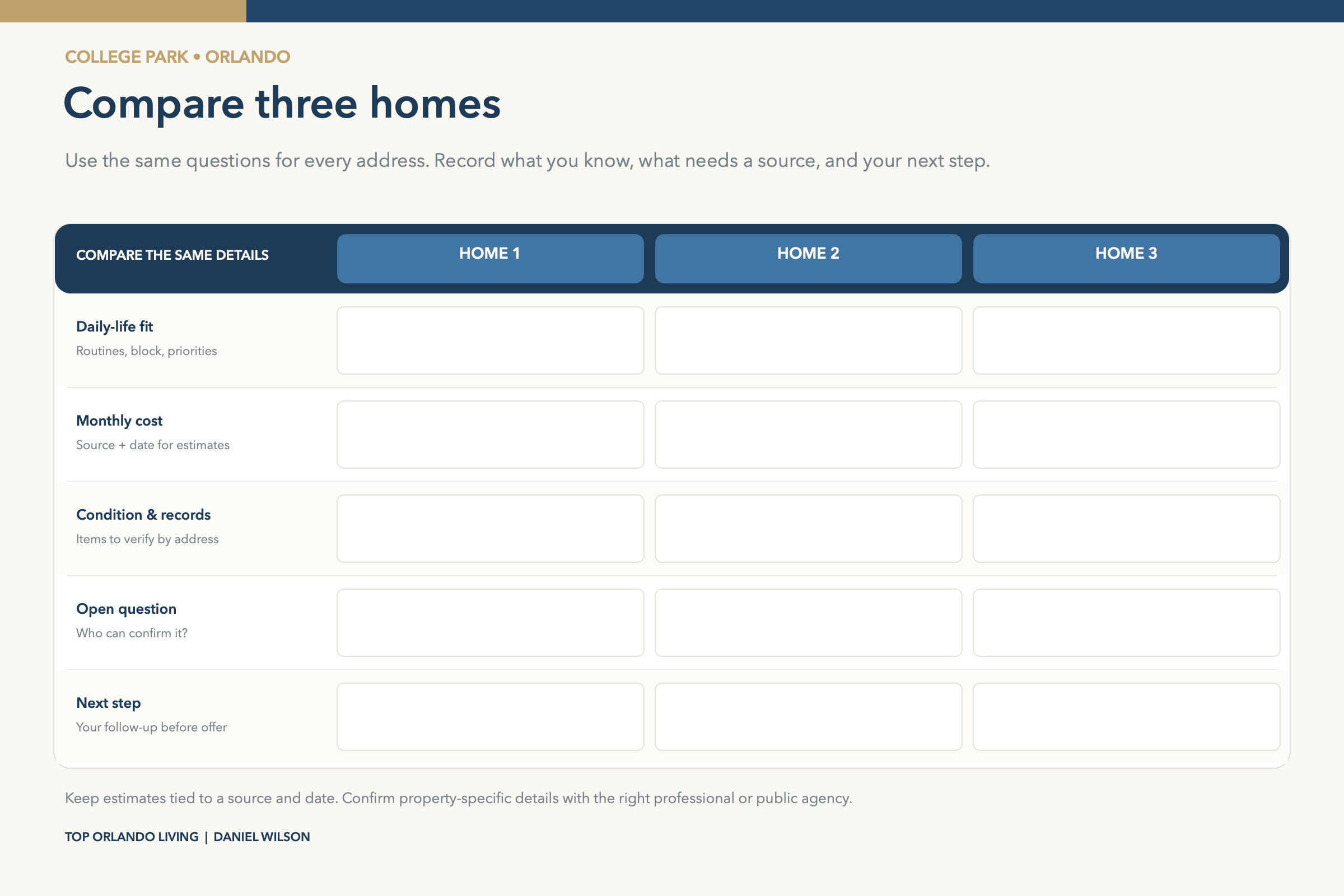
- Address and home type: __________________________________________
- Daily-life fit (rate 1–5): ______ What worked about the block or route? __________________
- Estimated monthly total: $__________ Source and date for taxes / insurance / association: __________________
- Condition or records to verify: __________________________________________
- Best feature for my priorities: __________________________________________
- Main trade-off or open question: __________________________________________
- Next step and who will confirm it: __________________________________________
Give each home the same review, then compare the notes. A score is a way to organize your own priorities—not an appraisal, inspection or recommendation to buy a specific property.
Planning to buy in College Park?
Daniel Wilson at Top Orlando Living | RE/MAX Town Centre can help you organize a College Park search around your budget, timing, home type and address-level questions. Send two or three listing links and your preferred timeline; together we can identify what to verify before you tour or make an offer. Do not send private financial or identity documents through a general contact form.
Request a College Park home search conversation or call (407) 808-9931. You can also explore the College Park Orlando real estate page and the Orlando Home Buyer Guide.
Buyer planning information only. Confirm property condition, zoning, permits, school assignment, flood exposure, insurance, taxes, association requirements, contract terms and title matters with the relevant professionals and public agencies.
